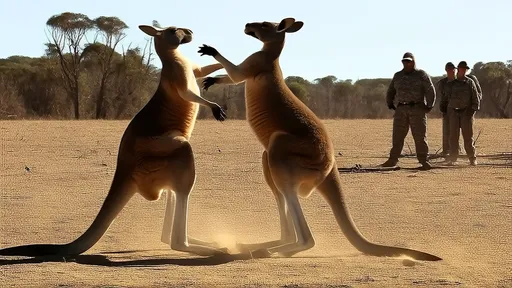
The sun beats down on the red earth of the Australian outback as two male kangaroos square off in a ritual as old as the continent itself. Their muscular tails prop them upright while powerful hind legs deliver kicks capable of disemboweling predators. This primal spectacle, once witnessed only by wildlife researchers and lucky tourists, has recently become the center of a heated ethical debate after a series of controversial wildlife interventions.
Across social media platforms, viral videos show park rangers and well-meaning bystanders attempting to break up kangaroo fights using methods ranging from loud noises to physical separation. The most contentious footage features a Queensland farmer who famously rugby-tackled a dominant male to save a younger rival from drowning in a waterhole. While hailed as a hero by some, wildlife experts quickly condemned his actions as dangerously anthropomorphic.
Dr. Eloise Pembroke, senior zoologist at the University of Melbourne, explains that what humans interpret as brutal violence often serves critical ecological functions. "Alpha males establish dominance through these encounters, which actually reduces overall conflict within mobs. When we interfere, we disrupt social hierarchies that keep populations stable," she says, noting that drought conditions have intensified competition for resources and made confrontations more visible to humans.
The debate extends beyond academic circles. Rural communities report increasing calls to wildlife hotlines from distressed tourists demanding intervention in natural kangaroo behaviors. Some cattle stations have begun offering "kangaroo mediation workshops" to educate visitors, while others capitalize on the phenomenon by selling tickets to guided tours promising "up-close encounters with boxing roos."
Cultural attitudes play a significant role in the controversy. Indigenous elders from the Yuin Nation have publicly criticized what they view as another example of European Australians misunderstanding the bush. Uncle Ray Williams, a knowledge keeper, describes kangaroo combat as "country law" that maintains balance. "Our creation stories tell of the first kangaroo teaching the right way to fight - with honor and purpose. Whitefellas see blood and want to stop it, but they don't see the whole story," he told the National Indigenous Times.
Complicating matters further are emerging concerns about animal welfare in extreme cases. Veterinarians in drought-affected regions report treating more kangaroos for fight-related injuries than in previous decades. Dr. Sarah Chen, who runs a wildlife clinic in Broken Hill, has documented cases of infected wounds and broken bones. "There's a difference between natural selection and unnecessary suffering," she argues, advocating for case-by-case assessments rather than blanket non-intervention policies.
The tourism industry finds itself caught between ethics and economics. After a German backpacker's viral video showed her screaming at fighting kangaroos on Fraser Island, the local council implemented mandatory wildlife interaction briefings. Meanwhile, several wildlife parks have discontinued kangaroo feeding experiences due to increased aggression during dry seasons. Mark Thompson, CEO of Outback Adventures, admits the dilemma: "We want visitors to appreciate nature's raw beauty, but nobody wants to see joeys orphaned because some bloke decided to play referee."
Technological solutions are emerging on both sides of the debate. Conservation groups trial AI-powered monitoring systems that distinguish between normal sparring and potentially lethal conflicts, while farmers experiment with drone deployments to scatter fighting mobs near livestock. The most surprising innovation comes from a Darwin-based startup developing "roo-proof" watering stations designed to prevent territorial disputes - essentially creating separate drinking areas for dominant and juvenile males.
Legal frameworks struggle to keep pace with the controversy. While all Australian states prohibit interfering with protected wildlife, definitions vary widely. Tasmania explicitly bans disrupting natural animal behaviors, whereas Northern Territory legislation contains loopholes allowing "emergency welfare interventions." This patchwork of regulations creates confusion for both citizens and law enforcement, particularly in border regions.
As climate change alters traditional kangaroo habitats and behaviors, scientists warn that human-wildlife conflicts will escalate. The current debate over boxing kangaroos may foreshadow larger ethical questions about humanity's role in managing nature. For now, the outback continues its ancient rhythms - with or without human referees - as evolutionary forces shape the next generation of Australia's iconic marsupials.

By /Jul 15, 2025

By /Jul 15, 2025

By /Jul 15, 2025

By /Jul 15, 2025

By /Jul 15, 2025

By /Jul 15, 2025

By /Jul 15, 2025

By /Jul 15, 2025
By /Jul 15, 2025

By /Jul 15, 2025

By /Jul 15, 2025

By /Jul 15, 2025

By /Jul 15, 2025
By /Jul 15, 2025

By /Jul 15, 2025
By /Jul 15, 2025

By /Jul 15, 2025

By /Jul 15, 2025