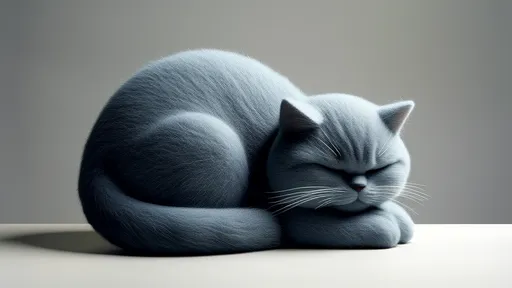
The world of feline-inspired art has taken an unexpected technological leap with the emergence of electrostatic flocking techniques in cat hair felting. What began as a traditional craft practiced by patient artisans has transformed into a cutting-edge fusion of biology, physics, and contemporary art. This peculiar marriage of ancient felting methods and modern electrostatic applications is producing startlingly lifelike three-dimensional cat portraits that challenge our perception of textile art.
At the heart of this revolution lies the innovative adaptation of industrial electrostatic flocking - a process traditionally used to create velvety surfaces on everything from dashboard ornaments to disposable gloves. Artists specializing in cat hair portraiture have discovered that by applying controlled electrostatic charges to carefully collected feline fur, they can achieve unprecedented precision in their wool-and-hair compositions. The technique allows individual strands of cat hair to stand vertically, mimicking the natural lie of fur on a living animal with remarkable accuracy.
The process begins with the meticulous collection of shed fur from domestic cats, typically gathered through regular brushing sessions. Unlike conventional felting that relies solely on mechanical agitation and moisture to bind fibers, electrostatic cat hair felting employs specialized equipment to create temporary charge differentials. When applied to a prepared wool base, these charged cat hairs align themselves along electromagnetic field lines, creating startlingly realistic fur textures that appear to grow organically from the artwork's surface.
Pioneers in this field report that different cat breeds produce fur with distinct electrostatic properties. Long-haired varieties like Maine Coons and Persians tend to hold charges longer, allowing for more gradual adjustments during the creative process. Short-haired breeds like Siamese or Abyssinians require higher voltage applications but can achieve sharper detail work. Some artists even maintain databases tracking how individual cats' fur responds to various electrostatic conditions throughout seasonal shedding cycles.
The implications extend beyond mere technical achievement. This fusion of technology and traditional craft has sparked philosophical debates within the art community. Purists argue that the use of external energy sources violates the fundamental principles of hand felting, while innovators counter that all art forms evolve with available technologies. Meanwhile, collectors have demonstrated overwhelming enthusiasm, with electrostatic cat hair portraits commanding prices up to three times higher than traditional felted works at specialist auctions.
Scientific researchers have taken unexpected interest in these artistic developments. Materials scientists note that the electrostatic behavior of cat hair presents unique properties that challenge conventional models of fiber physics. Veterinary researchers have begun collaborating with felting artists to study how diet, health, and genetics affect the electrostatic qualities of feline fur. What began as an artistic curiosity may yield insights with applications ranging from biocompatible materials to advanced filtration systems.
Workshops teaching electrostatic cat hair felting techniques have sprung up globally, though the specialized equipment required - including modified Van de Graaff generators and precision voltage regulators - keeps the practice relatively exclusive. Safety protocols are rigorous, as improper handling of charged cat hair can lead to startling (though generally harmless) discharges. Anecdotes abound of artists receiving unexpected static shocks from particularly charged works-in-progress, or of cat hair spontaneously arranging itself into perfect formations during periods of atmospheric electrical activity.
The environmental impact of this art form presents an interesting paradox. While utilizing a renewable, biodegradable material that would otherwise be discarded, the energy requirements for large-scale electrostatic felting raise sustainability questions. Some studios have begun experimenting with solar-powered charging systems and reclaimed fur from animal shelters, positioning the practice as an eco-conscious art form. The Cat Fanciers' Association has even established guidelines for ethical fur sourcing, emphasizing that no cats should be brushed excessively or against their will for artistic purposes.
Looking forward, the potential applications of electrostatic cat hair manipulation extend far beyond portraiture. Architects have experimented with charged fur as an acoustic dampening material, while fashion designers have created striking garments that appear to ripple and shift as the wearer moves. The medical field has shown interest in how these techniques might inform new approaches to synthetic hair implants. What remains certain is that this peculiar intersection of craft and technology will continue to evolve in unexpected directions, much like the unpredictable behavior of the feline muses that inspire it.
As galleries begin dedicating entire exhibitions to electrostatic fiber art, and as more artists cross-train in both traditional felting techniques and electrical engineering, the boundaries of this medium continue to expand. The artworks themselves seem almost alive - their surfaces responding to atmospheric changes, their textures inviting touch yet resisting it through accumulated charge. In an age of digital art and virtual experiences, there's something profoundly tactile about these charged creations that resonates deeply with viewers, bridging the gap between our technological present and our ancient fascination with both cats and crafted objects.
By /Jul 15, 2025
By /Jul 15, 2025
By /Jul 15, 2025
By /Jul 15, 2025

By /Jul 15, 2025

By /Jul 15, 2025
By /Jul 15, 2025
By /Jul 15, 2025

By /Jul 15, 2025
By /Jul 15, 2025
By /Jul 15, 2025

By /Jul 15, 2025
By /Jul 15, 2025
By /Jul 15, 2025

By /Jul 15, 2025
By /Jul 15, 2025
By /Jul 15, 2025

By /Jul 15, 2025