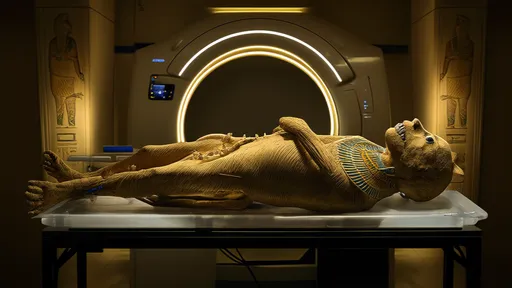
The recent CT scanning of an ancient Egyptian cat mummy has unveiled a fascinating and somewhat unsettling glimpse into the past. Researchers were able to create a detailed parasite map, revealing not only the physical structure of the mummified feline but also the hidden organisms that once thrived within it. This discovery opens a new window into understanding the health, environment, and even cultural practices of ancient Egypt.
The cat mummy in question was part of a larger collection housed in a European museum. Initially, it appeared to be a well-preserved artifact, but modern imaging technology allowed scientists to peer beneath the wrappings without causing damage. What they found was a complex ecosystem of parasites, including tapeworms and roundworms, which had been preserved alongside the cat for millennia. This suggests that the animal likely lived in conditions where parasitic infections were common, possibly in densely populated urban areas or temple grounds where cats were often kept.
The presence of these parasites provides valuable clues about the daily life of ancient Egyptian cats. Unlike wild felines, domesticated cats in Egypt were often revered and even worshipped, but their living conditions might not have been as pristine as their ceremonial status implied. The parasites indicate that these animals were exposed to contaminated food or water, or that they hunted rodents and other small prey that carried infections. This aligns with historical records describing cats as both pets and pest controllers in households and granaries.
One of the most striking findings was the variety of parasites detected. The CT scans revealed multiple species, some of which are still common in modern cats, while others are now rare or extinct. This diversity hints at a rich but hazardous ecological niche that ancient Egyptian cats occupied. Researchers were particularly intrigued by the evidence of larval stages embedded in the cat’s tissues, suggesting chronic infections that may have affected its health and behavior.
Beyond the biological implications, this study sheds light on the mummification process itself. The fact that parasites were preserved so well indicates that the embalming techniques used on animals were highly effective, even if unintentionally so. The Egyptians took great care in preparing animal mummies, often as offerings to gods like Bastet, the feline deity. The discovery of parasites adds a layer of realism to these ritual practices, reminding us that even sacred animals were not immune to the challenges of their environment.
This research also raises questions about the broader impact of parasites on ancient Egyptian society. If cats, which were often well cared for, carried such a heavy parasitic load, it’s likely that humans and other animals did as well. Future studies could explore whether similar infections were present in human mummies, offering insights into public health and hygiene practices of the time. The cat mummy’s parasite map might just be the first step in reconstructing a more complete picture of ancient Egyptian life.
The implications of this discovery extend beyond archaeology. Modern veterinarians and parasitologists can use this data to trace the evolution of parasitic species and their adaptations over thousands of years. Understanding how these organisms interacted with their hosts in the past could inform current efforts to control or eradicate similar parasites today. The cat mummy, once a silent relic, has become a vibrant source of scientific inquiry.
As technology advances, non-invasive techniques like CT scanning will continue to revolutionize the study of mummies. Each scan peels back another layer of history, revealing stories that were never meant to be told. The Egyptian cat mummy’s parasites are a reminder that even in death, these animals carry evidence of their lives—evidence that can still teach us something new about the ancient world and our place within it.
By /Jul 15, 2025
By /Jul 15, 2025

By /Jul 15, 2025
By /Jul 15, 2025

By /Jul 15, 2025

By /Jul 15, 2025
By /Jul 15, 2025

By /Jul 15, 2025

By /Jul 15, 2025

By /Jul 15, 2025
By /Jul 15, 2025

By /Jul 15, 2025
By /Jul 15, 2025
By /Jul 15, 2025

By /Jul 15, 2025

By /Jul 15, 2025

By /Jul 15, 2025

By /Jul 15, 2025